Enable High Contrast Mode
Disable High Contrast Mode
October 24, 2024

Iconic bridge over the Wallkill River on the Wallkill Valley Rail Trail, New Paltz. Photo courtesy of Rails to Trails Conservancy.
The Modest Beginnings of the Wallkill Valley Rail Trail
By Dave Strong

The Wallkill Valley Rail Trail in it’s current form. Click the image above for more information.
Part One – The Huguenot Path
The other day I rode a bike rented from “Bike New Paltz” along the Wallkill Valley Rail Trail down to PhilliesBridge Road from the Town & Country Condominiums in New Paltz, the place my wife, Laura Zeisel, and I now call home since we moved back from Vermont a year ago last July. (From the number of bikes in the racks where we live it looks like many of our immediate neighbors take similar advantage of our location). I hadn’t cycled in many years and, at the age of 78, the ride was both exhilarating and tiring. I passed many walkers coming and going, including a mother pushing a stroller, two photographers with camera-stands; and I exchanged nods with several fellow bicyclists on my six-mile round trip. I am looking forward to getting a bike of my own and to gradually extending my rides, in sections, over the Wallkill Valley Rail Trail’s entire length – from the Town of Gardiner’s southern border to the northern border of the Town of Ulster, something I could only have dreamed of when I moved to Vermont nearly 25 years ago. Now I dream of extending my rides to include the 6-mile River to Ridge Trail to the Mohonk Preserve and the Shawangunk Mountains and the 7-mile Hudson Valley Rail Trail to the walkway over the Hudson, and beyond – all part of an ever growing network of interconnected trails to explore that I never imagined possible.
The last time I was on a bicycle in New Paltz was probably in 1987, the year my young family moved from our home on Route 32 North, opposite Ulster BOCES, to Millrock Road in the village. Our daughters (then 6 and 9) learned how to ride bikes in the BOCES parking lot and, before the move we all ventured a short distance in either direction along the abandoned Wallkill Valley Railroad line.The rails had been removed and its rotting ties left in piles along the way later to be reincarnated as the Wallkill Valley Rail Trail. At the time, I was campaigning for the first of three four-year terms I enjoyed as a member of the New Paltz Town Board, and among my intentions was to promote the acquisition of the abandoned railroad line and its conversion into a linear park; measures previously rejected by the Town and Village governments in 1983, leaving it up for grabs.
I first became aware of the idea of a linear park in 1982, while serving on the Town of New Paltz Environmental Conservation Commission. That’s when the Town was notified that Conrail, as obliged by state and federal law, was offering its abandoned rail line for sale to public entities – first the state, then the counties, then municipalities – before opening it to private bidders. The state and county had passed on it, leaving it up to municipalities to determine its fate. The Commission hosted an informational meeting in November 1982 to discuss the idea of using the abandoned rail line as a recreational trail, as well as possible nature trails and local history pathways in the village that might be developed as offshoots. All at a time when wide-ranging networks of “Rail Trails” stretching for miles were not in existence. Our original idea did not even consider that possibility: it was focused on how the abandoned line could be utilized in town, particularly in the village, for recreation and environmental education.
Among those present at the informational meeting was village Beautification Committee member Dan Guenther. Dan was so animated by the idea that he volunteered to help research property ownership along the main trail route for one mile in each direction from the village center, to ascertain if Conrail’s title to the property was clear. Subsequently, with the support of the entire Commission, fellow Commission member Alan Stout (founder of the Bike Rack) and I co-authored a report which was submitted to the Town Board in October 1983, recommending that the New Paltz section of the abandoned rail line be acquired for use as a recreational trail, as a buffer for historic Huguenot Street, and as a catalyst for future efforts to protect the environment. The sales price offered by Conrail for the 59.05 acres containing 12.2 miles of trail at the time was $65,000. However, the Town Board did not welcome the idea, with Town Supervisor Bill Yeaple citing taxpayer concerns, conversion and maintenance costs, liability exposure, and the negative impact it would have on the peace, quiet, and security of adjoining landowners.

Author Dave Strong (left) at a ceremony in 1987 in Albany receiving an award on behalf of the New Paltz Environmental Conservation Commission from Thomas Jorling, NYS Commissioner of the Department of Environmental Conservation (right) for creating the “Huguenot Path”. (The woman in the center is unidentified).
But the Town Environmental Commission members (who, in addition to Alan and myself, included Al Marks, Warren McKeon, Seldon Spencer, Bob Lasher, Jeff Clock, and Anne Sarrantonio, as I recall) had been energized by the idea and the feedback we had gotten from the community, so we proceeded to create a trail system on the Town’s behalf close by the abandoned rail line. This is where what is now known as the Nyquist-Harcourt Wildlife Sanctuary (then simply the “Harcourt Wildlife Sanctuary”) got its start: in a nature trail we called the “Huguenot Path”. At the time, the Huguenot Historical Society (now “Historic Huguenot Street”) owned this low-lying, 56-acre parcel on the west side of Huguenot Street filled with woods and brush and a curving series of wetlands and ponds that trace the former course of an “oxbow”, a meander in the river that was cut off ages ago when the river straightened its course. The Huguenot Historical Society allowed the Environmental Commission to establish and manage a one-mile nature trail through the eastern half of the property. (The Thomas and Corinne Nyquist Foundation acquired the property in 2011 and assumed responsibility for managing it until last year, when it was conveyed to the Wallkill Valley Land Trust).
That path breaking effort, which today features a much more extensive trail system than the original horseshoe-shaped loop between two entry points off Historic Huguenot Street, was constructed entirely with volunteer labor over a period of two years, aided by $1,000 in donations from local businesses for materials. The opening of “Huguenot Path” was celebrated on November 16, 1984. Attendees at the event included Tom Nyquist (who lived across the street from the northern trailhead and was then a Village Trustee), Bob Lasher (later was a founding member of the Wallkill Valley Land Trust), Ken Hasbrouck (Executive Director of the Huguenot Historical Society), Irene Martin (Town Historian), Warren and Ann McKeon, Alan Stout, Charles and Lois Stokes, Mae DeMaria (Town Clerk), Mark Kissinger (then a Boy Scout) and others. As it turned out, the development of the Huguenot Path – which mobilized a score of volunteers for the planning, funding, clearing and signing of the trail system as well as the construction of an 80-foot walking bridge – proved to be a dress rehearsal for the much bigger task of developing and managing the property known today as the Wallkill Valley Rail Trail (which now, like the former Huguenot Path, is managed by the Wallkill Valley Land Trust).

Map of “The Huguenot Path” circa 1984. The path was developed by the Environmental Conservation Commission of the Town of New Paltz.
Part Two – The Wallkill Valley Rail Trail
Although the story of the acquisition and subsequent development of the Wallkill Valley Rail Trail is available on the Wallkill Valley Land Trust website and, in greater detail, in Carleton Mabee’s book Listen to the Whistle: Anecdotal History of the Wallkill Valley Railroad (published in 1994), the backstory involving the “Huguenot Path” has never been told. As it happened, three years after the Town turned down its opportunity to purchase the abandoned section of Conrail line in New Paltz, the New Paltz-Gardiner section remained unsold. This fact was revealed in 1986, when news stories reported that Conrail sold its right of way from the Rosendale town line north to Kingston for $1.00 to someone who was adamant he was legally entitled to restore train service on the whole Wallkill line. Rumors circulated that speculators had an option to buy the New Paltz section and were planning to subdivide it for sale to adjoining landowners. In 1987, believing that, with the right political leadership, the town still had a chance to successfully acquire its portion of the rail line, I considered running for the Town Board.
But, as a relative newcomer with two young children, I first approached Dan Guenther, who I had first gotten to know during public discussions about a future rail trail and his subsequent assistance with the Huguenot Path. After we reviewed all the benefits a rail trail through the village, running alongside the historic district, and the Wallkill River, could provide, as well as the imminent threat of its acquisition and break-up by private interests, I asked Dan, as a well-liked, longtime resident, if he would be willing to stand for election to the Town Board in order to shepherd it through, politically. He demurred and encouraged me to enter the race instead, with the pledge that he would be in the forefront of the battle to convince town officials and the public of the value of securing the property for future recreational use.
And Dan was true to his word. He, along with other folks who had coalesced around the creation of the Huguenot Path, would form the core of the group that lobbied long and hard for the purchase of the section of the line in New Paltz. And when that effort succeeded, the experience and contacts gained by the Environmental Commission in building the Huguenot Path, were utilized for the task of converting the former railroad line into a linear park. When Conrail insisted on selling all of the Gardiner-New Paltz section in one piece (and the law prohibited a town from owning property in another town), the newly-formed Wallkill Valley Land Trust was called upon to act an “umbrella agency” to purchase the New Paltz-Gardiner section, sell back the New Paltz section to the Town and the Village with conservation easements and retain ownership of the Gardiner section (with the hope the Town of Gardiner would buy it), which it readily agreed to do. Conditioned on the success of that arrangement, in 1988, the Town and Village Boards approved a motion of intent to purchase their portions of the trail.
For that arrangement to be implemented, the Land Trust needed to raise funds for its purchase of the Gardiner section and to obtain assistance in reviewing title to the property and developing baseline data for the conservation easement it would impose as part of the re-sale agreement. Many other details needed to be worked out, as well – where to get the funds for the New Paltz municipalities to purchase and develop it, how it was going to be planned and maintained, and mitigating concerns of adjoining landowners. As noted by Carleton Mabee, the rail trail project “had many doubters and many opponents”, and at any moment during the two-year interval between agreeing in principle and actually signing a contract to purchase, governmental approval could have been rescinded. The election results in November 1987 that put me (an independent) and my running mate for the Town Council, Mark Sherman (a liberal Democrat) into office had added two firm supporters of the rail trail to the board, but it took the November 1989 defeat of the longtime Conservative/Democratic Town Supervisor, Bill Yeaple, and his replacement by the liberal Republican Dave Lent (a supporter of the future rail trail), to insure that the Town Board would follow through on its prior commitment.
To relieve concerns about the cost of the project, the Town applied for and received a state matching grant of $88,000 to be used to develop the trail as well as to pay for half the purchase price. The grant was written by Glenn Gidaly and Laura Walls. Two of the five members of the Town Board, supported by vocal critics of the proposed rail trail, voted against the grant application and its acceptance when awarded. In order to quell concerns over the tax burden of ongoing maintenance as well as the cost of making the property usable and safe (which included installing decking and railings on the bridges over the Plattekill Creek and the Wallkill River), project supporters had pledged to organize a non-profit membership association – the Wallkill Valley Rail Trail Association – to carry out those tasks and to satisfy the requirements of the 50-50 matching grant through fundraising and volunteer labor.
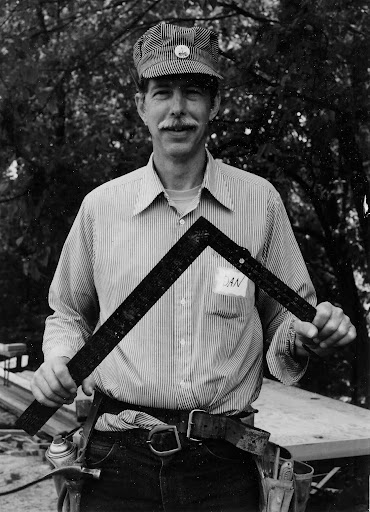
Dan Guenther (1943-2021) in his role as the “engineer” of the Wallkill Valley Rail Trail during the volunteer effort he organized that re-decked and added benches to the 250-foot former railroad bridge over the Wallkill River in May 1993. Members of the Bruderhof Community in Rifton were among those who helped complete this daunting project in one day’s time.
The formation of that organization coincided with the purchase of the Rail Trail for $175,000, which included a conservation easement overseen by the Wallkill Valley Land Trust, in January 1991. Dan Guenther was its acting president. At its first annual meeting in May 1991, the following people were unanimously elected to the board of directors: Bob Lasher, Maddy Swirsky, Lynn Bowdery, Vici Danskin, Roland Bahret, Steve Ruelke, Dan Guenther, Linda Pacquin, and Cora LeFevre (elected to the board), and Roland Bahret was elected President. Thanks to the thousands of hours of labor contributed by the 150-member Wallkill Valley Rail Trail Association and the assistance of the Wallkill Land Trust, the official opening of the twelve-mile New Paltz-Gardiner linear park was celebrated on October 9, 1993, with the Wallkill Valley Rail Trail Association in charge of management responsibilities over what was quite possibly the first municipally-owned Rail Trail in the country. [Note: The Gardiner section was transferred to the Town of Gardiner with a conservation easement in 2007, and the northern section, extending 11.5 miles from Rosendale through Ulster to Kingston, was acquired in 2009].
Conclusion
As I biked over the Plattekill Creek gorge on the rail trail the other day, I thought of Dan and the incredible work he and other volunteers had done as volunteers to open up the trail for bikes and pedestrians, culminating in the decking of the former RR bridge over the Wallkill River. It reminded me of the modest bridge we had built over the oxbow for the Huguenot Path ten years before, and how the Huguenot Path had served as a stepping-stone for the subsequent development of Wallkill Valley Rail Trail – two local trail systems now conserved and overseen by the Wallkill Valley Land Trust.
Of all the changes in New Paltz in the town’s physical environment in my 24-year absence, good and bad, it is easy to recognize that the addition of an unmatched array of pedestrian and cycling opportunities, as well as nature trails accessible from the village, are the most lasting and dramatic. This includes the most recent addition – the 134-acre Millbrook Preserve with 4 miles of trails that borders Duzine Elementary School, Woodland Pond Retirement Community, and North Manheim Boulevard. These substantial public improvements of incalculable value are a testament to the extraordinary work of all those involved in non-profit associations and local government whose coordinated efforts these achievements have undoubtedly required. And the people of New Paltz and neighboring towns are indeed fortunate in having the Wallkill Valley Land Trust at their side to help preserve, maintain, and conserve what is vitally important to the present and future quality of life in our region.
– Written October 16, 2024
The author welcomes comments and reminiscences about the early development of what is now the Nyquist-Harcourt Wildlife Sanctuary and/or the Wallkill Valley Rail Trail. Email dstrong@vtlink.net or call 845-255-8518.